JKSSB Releases Syllabus for Veterinary Pharmacist and Assistant Compiler Posts Under Notification No. 03 of 2026
JKSSB Releases Syllabus for Veterinary Pharmacist and Assistant Compiler Posts Under Notification No. 03 of 2026
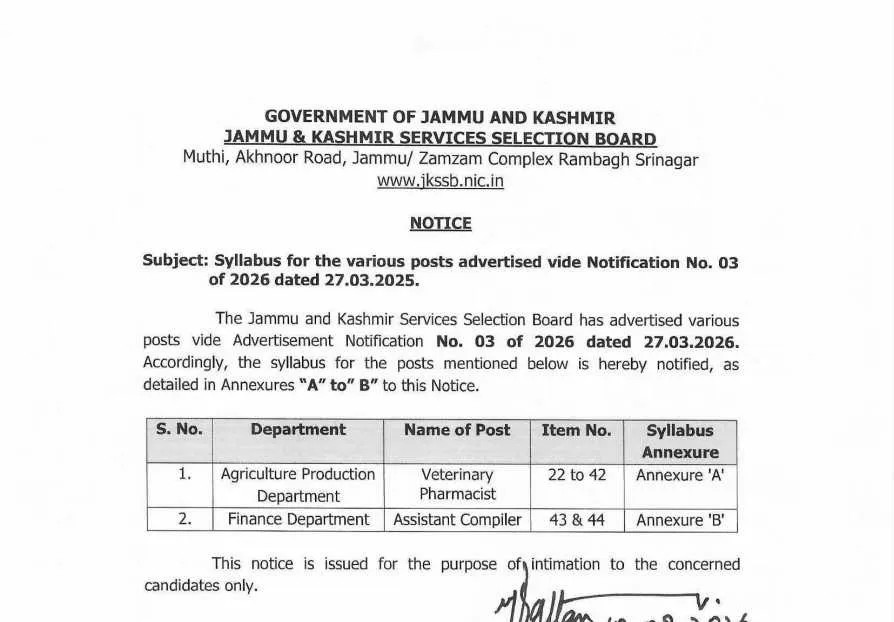
The Jammu and Kashmir Services Selection Board (JKSSB) has released the syllabus for various posts advertised under Advertisement Notification No. 03 of 2026. The syllabus notice, dated August 10, 2026, covers the posts of Veterinary Pharmacist under the Agriculture Production Department and Assistant Compiler under the Finance Department.
The official notice states that the syllabus for the concerned posts has been notified through separate annexures. The Veterinary Pharmacist syllabus is provided in Annexure “A”, while the syllabus for Assistant Compiler is given in Annexure “B”. The Veterinary Pharmacist post corresponds to Item Nos. 22 to 42, whereas Assistant Compiler corresponds to Item Nos. 43 and 44.
JKSSB Veterinary Pharmacist Syllabus 2026
According to Annexure “A”, the written examination for the post of Veterinary Pharmacist will carry 120 marks and comprise 120 questions. The prescribed duration of the examination is two hours. The paper is divided into two broad components: Aptitude and Subject Related sections, with 60 marks allocated to each.
The Aptitude section carries 60 questions. It includes General English with 15 questions, General Knowledge and Current Affairs (India) with 15 questions, General Knowledge with special reference to J&K with five questions, Numerical and Reasoning Ability with 15 questions, and Basic Concepts of Computers with 10 questions. Together, these components account for the full 60 marks of the Aptitude section.
The Subject Related section also carries 60 questions and is divided equally among six subjects. These include Animal Diversity I, Animal Diversity II, Animal Diversity III, Comparative Physiology & Anatomy, Evolution, and Immunology, with 10 questions allocated to each subject.
General English Topics
The General English portion includes several language and grammar-related areas. Candidates are required to prepare topics such as articles, clauses, pronouns, homonyms and homophones, tenses, punctuation, synonyms and antonyms, analogies, idioms and phrases, and the uses of prepositions.
General Knowledge and Current Affairs
The General Knowledge and Current Affairs section covers a broad range of subjects related to India. The syllabus includes important dates in Indian history and the freedom struggle, major events, firsts in the world and India, popular personalities, books and authors, famous places, languages, capitals and currencies.
It also includes the United Nations and its principal organs, SAARC and ASEAN, everyday science, world-famous awards, national awards, sports, climate and crops in India, the Constitution of India, democratic institutions, forms of government, political and physical divisions, important rivers and lakes, national and international current events, agriculture and economic development, centrally sponsored schemes, and Indian foreign trade.
J&K-Specific General Knowledge
The syllabus also gives specific importance to Jammu and Kashmir-related knowledge. This portion includes abbreviations, important dates, personalities and their achievements or contributions, weather and climate, crops, means of transport, important power projects and their impact on the J&K economy, rivers and lakes, tourist destinations, and the history of J&K and its historical places.
Candidates are also required to cover the Right to Information Act, the Indus Water Treaty and its impact on the economy, agriculture in economic development, industrialization and economic development, along with current events of local, national and international importance.
Numerical and Reasoning Ability
The Numerical and Reasoning Ability section is based primarily on fundamental mathematical concepts and application-oriented reasoning. The broad mathematical areas include number systems, percentages, averages, profit and loss, ratio and proportion, speed, distance and time, mathematical reasoning, basic algebra, mensuration, decimal fractions, simple and compound interest, trigonometry, and simplification.
The reasoning component covers number series, letter series, coding-decoding, direction sense, blood relations, statements and conclusions, logical reasoning, mental reasoning, sequential output tracing, assertions and reasons, and arithmetical operations.
Basic Computer Concepts
The computer section will assess candidates on basic computer concepts and their applications. The notified topics include computer terminology, hardware and software, input and output devices, MS Word and MS Excel, storage and operating systems, safety and security, email and internet usage, and search engines.
Subject-Related Syllabus for Veterinary Pharmacist
The subject-specific portion begins with Animal Diversity I, covering topics under Protista, Porifera, Cnidaria, Helminthes and Annelida. The syllabus includes general characteristics and classification, locomotion in Protozoa, the canal system in Porifera, polymorphism in Hydrozoa, life histories of Taenia solium and Ascaris lumbricoides, parasitic adaptations and filter feeding in polychaetes.
Animal Diversity II includes Arthropoda, Mollusca, Echinodermata, Urochordates and Cephalochordates. Topics include vision in Arthropoda, metamorphosis in insects, torsion in gastropods, the water-vascular system in Asteroidea, and the phylogeny and classification of protochordates.
Animal Diversity III covers Pisces, Amphibia, Reptiles, Aves and Mammals. The prescribed areas include classification, osmoregulation in fishes, parental care in amphibians, poisonous and non-poisonous snakes, flight adaptations in birds, and adaptive radiation in mammals.
The Comparative Physiology & Anatomy section includes the digestive system, digestion and absorption, respiration and the respiratory system, excretion and the excretory system, and the nervous system and sense organs. Topics include respiratory volumes and capacities, oxygen and carbon dioxide transport in blood, respiratory pigments, oxygen dissociation curves, gills, lungs, air sacs, swim bladder, nitrogenous waste formation and excretion, the evolution of kidneys and urinogenital ducts, and the physiology of vision and hearing.
The Evolution unit covers Lamarckism, Darwinism and Neo-Darwinism, evidence of evolution, fossils and their dating, horse phylogeny, organic variations, isolating mechanisms, natural selection, industrial melanism, directional, stabilizing and disruptive selection, artificial selection, the biological species concept, and allopatric and sympatric speciation.
The final subject-related unit, Immunology, includes the basic properties of antigens, B and T cell epitopes and adjuvants, antibody structure and classes, monoclonal antibodies, antigen-antibody interactions, MHC structure and functions, antigen presentation and processing pathways, cytokines, and the complement system.
Assistant Compiler Syllabus
The notice also includes the syllabus for the Assistant Compiler post under Annexure “B”. The written test carries 120 marks and has a duration of two hours. The prescribed syllabus covers General English, Mathematics, History, Civics, Geography, General Knowledge and Current Affairs, General Knowledge with special reference to the UT of J&K, and Mental Ability.
The General English component includes paragraph writing and comprehension, editing and proofreading, rearrangement of jumbled sentences, dialogue, narration, models, articles, clauses, punctuation, synonyms and antonyms, pairs of words, idioms and phrases, and uses of prepositions. Mathematics covers areas including surface areas and volumes, conversion of metallic solids, profit and loss, simple and compound interest, linear equations in two variables, progression, BODMAS and simple probability.
The History portion includes the Revolt of 1857, the rise of the national movement, formation of the Indian National Congress, the rise of extremism, the Partition of Bengal, the Boycott and Swadeshi Movement, the rise of the Muslim League, the Khilafat and Non-Cooperation Movements, the Quit India Movement, and Independence and Partition of India.
The Civics and Geography sections cover democracy, Fundamental Rights and Duties, Directive Principles, public opinion, representation, franchise, elections, languages, the United Nations, seasons, planets, forests, forest conservation, national and zoological parks, wildlife sanctuaries, water resources, rainwater harvesting and routes in the UT of J&K.
The General Knowledge section includes abbreviations, personalities, geographical discoveries, Indian languages, capitals and currencies, international organisations, regional organisations and blocs, India's space and atomic research programmes, honours and prizes, sports, exports and imports, GDP, GNP, per capita income, and thermal, nuclear and hydro power plants in India.
For J&K-specific knowledge, the syllabus includes personalities and their contributions, weather, climate, crops, means of transport, J&K history, economy and culture, flora and fauna, rivers and lakes, tourist destinations, the J&K Panchayati Raj Act, 1989, the 73rd and 74th Constitutional Amendments, and the J&K Reorganisation Act, 2019. The Mental Ability section includes number and letter series, coding-decoding, direction sense, blood relations, mathematical reasoning, speed-distance-time, and statements and conclusions.
The JKSSB notice is dated August 10, 2026 and states that it has been issued for the information of the concerned candidates.
Official PDF: https://jkssb.nic.in/Pdf/Syllabus_03OF2026_10082026.pdf
Found this helpful? Share it 👇
Editorial Desk
The KSA Education newsroom tracks every exam notice, scholarship window and admission update that matters to students — and explains what to do next, in plain language.
Related articles

After MBBS interns. Veterinary students launch stipend protest across J&K, seek enhancement of allowance
After MBBS interns. Veterinary students launch stipend protest across J&K, seek enhancement of allowance
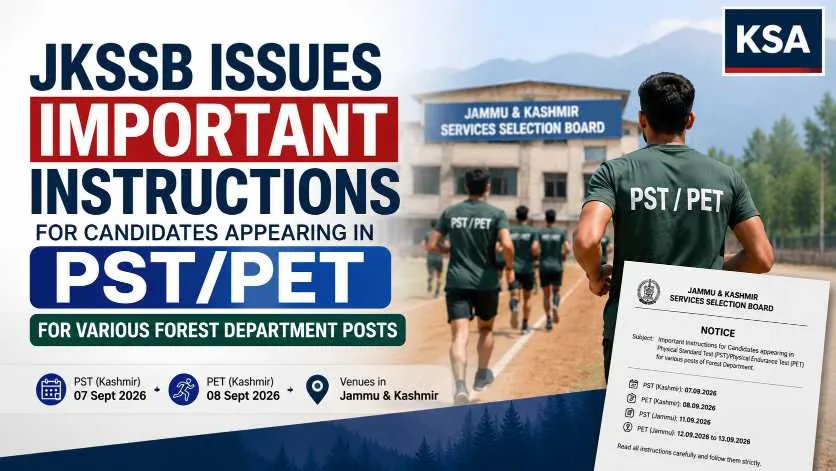
JKSSB Issues Important Instructions for Candidates Appearing in PST/PET for Forest Department Posts
JKSSB Issues Important Instructions for Candidates Appearing in PST/PET for Forest Department Posts
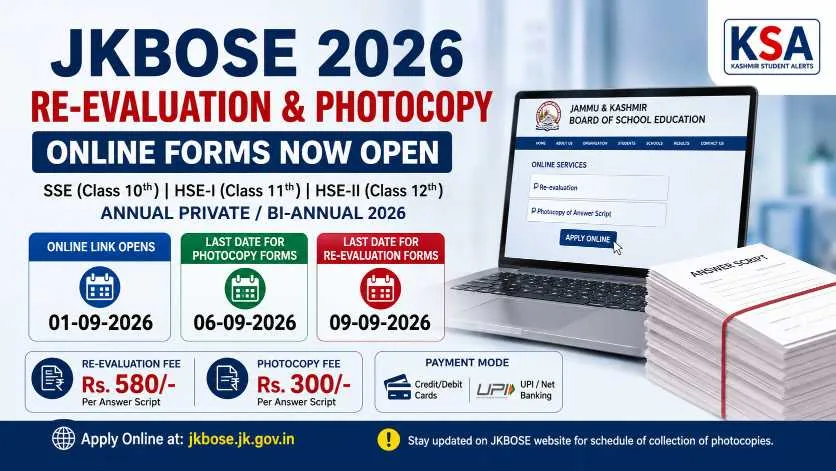
JKBOSE Re-Evaluation 2026: Online Forms Open for Class 10th, 11th & 12th; Check Dates and Fees
JKBOSE Re-Evaluation 2026: Online Forms Open for Class 10th, 11th & 12th; Check Dates and Fees
JKBOPEE Provisional Selection List 2026 Released for B.Sc Nursing & Paramedical Courses; Check Admission Dates
J&K BOPEE Provisional Selection List 2026 Released for BSc Nursing, Paramedical & Technology Courses; Check Admission Dates and Guidelines