How to Write a Scholarship Essay That Actually Gets Remembered
Selection panels read hundreds of essays. Here's how to write one they don't forget — without exaggerating a thing.

A scholarship essay is your one chance to be a person instead of a number. Selection panels read hundreds of them, and the essays they remember are rarely the fanciest or the most dramatic. They are the clearest, most honest, and most specific. The good news is that clear and honest is something anyone can learn to write.
Open with something real
Skip the grand quotation and the generic "education is the key to success" opening. Panels have read those a thousand times. Start instead with a specific moment, goal, or challenge that genuinely matters to you. Real beats impressive every single time, and a concrete opening earns the reader's attention.
Answer the actual question
If the prompt asks why the funding matters to you, tell them — plainly and directly. Do not drift into a full autobiography. One focused point, explained well, outperforms five vague ones scattered across the page. Structure it simply:
- Say what you want to study and why it matters to you.
- Say what the support would concretely change for you.
- Say what you intend to do with the opportunity.
Cut the padding
Long words and long sentences hide your meaning rather than showcasing it. Short, direct writing signals confidence and respect for the reader's time. After a first draft, read it aloud and delete anything you stumble over. If a sentence does not add something, remove it.
Show, don't just claim
Instead of stating that you are hardworking or determined, show it with a brief, real example. A single concrete detail — a project you finished, a difficulty you worked through — is more convincing than a paragraph of adjectives. Let the panel draw the conclusion themselves.
Be scrupulously honest
Never exaggerate achievements or invent hardship. Experienced panels can sense it, and sincerity is far more persuasive than performance. The truth, told clearly and with a little courage, is your strongest possible essay. It is also the version you can stand behind confidently if asked about it later.
Revise, then let it sound like you
Write the essay early so you have time to revise it with fresh eyes. Fix the errors, tighten the sentences — and then stop before you polish all the personality out of it. The best scholarship essays sound like a real, thoughtful student, not a template.
Common questions about scholarship essays
How long should it be?
As long as the guidelines allow and no longer. Say what matters clearly, then stop. Padding to fill a word count weakens an essay.
Should I use big, impressive vocabulary?
No. Clarity beats complexity. Write the way a thoughtful person speaks, not the way a thesaurus suggests.
Can I reuse one essay for many scholarships?
You can reuse a strong core, but always adapt it to each prompt. A tailored essay reads far better than an obviously recycled one.
Write it early, revise it once, and let it sound like you.
Found this helpful? Share it 👇
Editorial Desk
The KSA Education newsroom tracks every exam notice, scholarship window and admission update that matters to students — and explains what to do next, in plain language.
Related articles

Raman Kant Munjal Scholarships 2026-27: Check Eligibility, Rewards, Courses and Apply Online
Raman Kant Munjal Scholarships 2026-27: Check Eligibility, Rewards, Courses and Apply Online
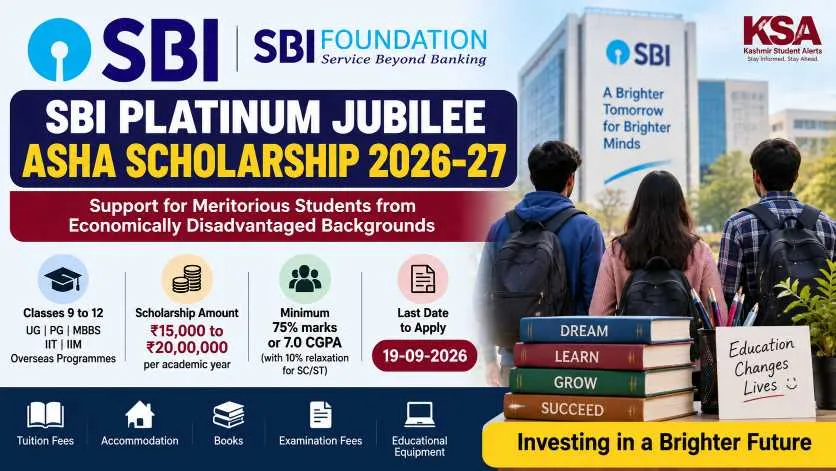
SBI Platinum Jubilee Asha Scholarship 2026-27: Eligibility, Benefits, Last Date and How to Apply
SBI Platinum Jubilee Asha Scholarship 2026-27: Eligibility, Benefits, Last Date and How to Apply

LIC Golden Jubilee Scholarship 2026-27: Apply Online, Eligibility, Rewards, Last Date & Full Details
LIC Golden Jubilee Scholarship 2026-27: Apply Online, Eligibility, Rewards, Last Date & Full Details

Raman Kant Munjal Scholarships 2026-27: Eligibility, Benefits, Application Deadline and How to Apply
Raman Kant Munjal Scholarships 2026-27: Eligibility, Benefits, Application Deadline and How to Apply