Supreme Court Reduces Judicial Service Exam Practice Requirement From 3 Years to 1 Year, Introduces Two-Year Training
The Supreme Court has reduced the legal practice requirement for Civil Judge recruitment from three years to one year, while introducing two
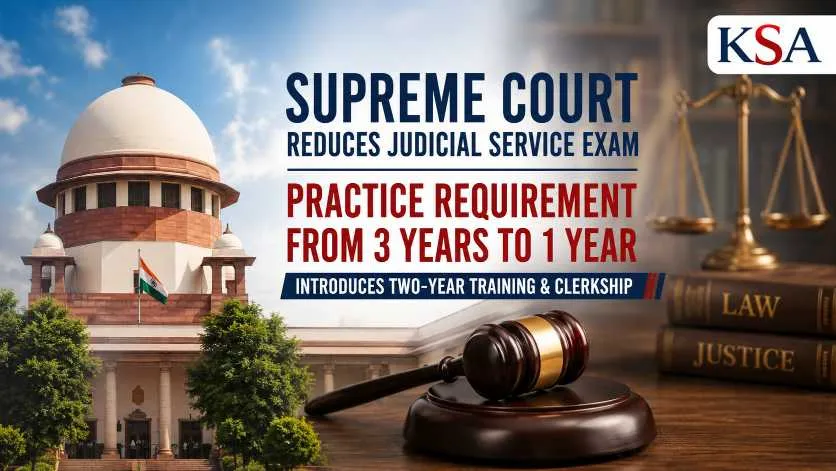
Law graduates preparing for entry-level judicial service examinations have received a significant change in eligibility requirements after the Supreme Court reduced the mandatory period of legal practice for Civil Judge (Junior Division) recruitment.
The Supreme Court has reduced the required legal practice experience from three years to one year for candidates seeking entry-level judicial service positions. The decision changes the earlier eligibility requirement while retaining the importance of practical legal exposure through a new training and clerkship framework.
The ruling was delivered by a 2:1 majority. The bench consisted of Chief Justice Surya Kant, Justice Augustine George Masih and Justice K Vinod Chandran, with Justice K Vinod Chandran dissenting.
The decision was reported on August 22, 2026, and changes the eligibility pathway for law graduates who want to appear for Civil Judge examinations.
Under the revised arrangement, candidates will no longer have to complete three years of legal practice before becoming eligible for the entry-level judicial service examination. Instead, the mandatory practice requirement has been reduced to one year.
However, the Supreme Court has not removed practical exposure from the pathway to judicial service. Rather, the new system shifts a significant portion of practical learning into a structured period that candidates will undergo after selection.
This means that qualifying for the examination will not immediately result in candidates taking charge as regular Civil Judges. Selected candidates will first enter a training and clerkship process designed to provide practical exposure before they move into regular judicial service.
Legal Practice Requirement Reduced From Three Years to One
The central change introduced by the Supreme Court concerns the amount of legal practice required before candidates can appear for the Civil Judge (Junior Division) recruitment examination.
Previously, candidates were required to have three years of legal practice. Under the new ruling, this requirement has been reduced to one year.
The change provides a shorter pre-examination practice requirement for law graduates seeking to enter the judicial service. Instead of waiting until they have completed three years of legal practice, eligible candidates under the new system will need one year of actual legal practice for recruitment notifications issued from April 1, 2027.
The reduction does not mean that practical legal experience has been removed from the judicial service pathway.
The Supreme Court has retained the importance of courtroom and legal exposure by introducing a structured system for candidates who are selected through the examination. That system consists of intensive training and a law clerkship period.
The new arrangement therefore changes when practical experience is acquired rather than eliminating the practical component altogether.
Candidates will have a shorter practice requirement before the examination, while those who are selected will subsequently spend two years undergoing structured training and clerkship before entering regular judicial service.
Transitional Relief for Fresh Law Graduates
The Supreme Court has also provided transitional relief for law graduates who fall between the earlier eligibility framework and the revised system.
According to the reported details of the ruling, candidates will receive an exemption from the prior practice requirement for recruitment notifications issued between May 20, 2025, and March 31, 2027.
For these recruitment notifications, law graduates can apply without prior legal practice. For eligibility purposes, such candidates will be treated as having completed one year of practice.
This transitional provision is important because it creates a temporary arrangement for candidates covered by recruitment notifications issued during the specified period.
Therefore, candidates applying under recruitment notifications issued between May 20, 2025, and March 31, 2027, will not be required to demonstrate prior practice to meet the one-year eligibility condition. They will instead be treated as having completed the required one year of practice.
The transitional arrangement has a specific end date.
From April 1, 2027, candidates will have to satisfy the one-year actual legal practice requirement before appearing for the Civil Judge examination.
The distinction between the transitional period and the rules applicable from April 1, 2027, is therefore important for law graduates planning to pursue judicial service.
What Changes From April 1, 2027?
The Supreme Court's revised arrangement establishes April 1, 2027, as an important point in the implementation of the new eligibility requirement.
For recruitment notifications issued from April 1, 2027, candidates will need at least one year of actual legal practice before appearing for the Civil Judge examination.
This differs from the transitional provision applicable to notifications issued between May 20, 2025, and March 31, 2027.
During the transitional period, fresh law graduates can apply without prior practice and will be treated as having completed one year of practice for eligibility purposes.
After the transition ends, the requirement will become an actual one-year practice condition.
The revised framework therefore creates two distinct stages.
The first is the transitional period, covering recruitment notifications issued between May 20, 2025, and March 31, 2027. The second begins with recruitment notifications issued from April 1, 2027, when candidates must have completed one year of actual legal practice.
This timeline is a key part of the Supreme Court's revised eligibility structure.
Selection Will Not Mean Immediate Appointment as a Regular Civil Judge
Another major aspect of the new framework is what happens after a candidate successfully clears the judicial service selection process.
Under the revised system, selection will not mean that a candidate immediately takes charge as a regular Civil Judge.
Instead, selected candidates will initially become Trainee Judicial Officers.
This creates an additional stage between selection and regular judicial service.
Candidates selected through the judicial service examination will have to complete structured practical training before moving into regular judicial service.
The system is intended to provide selected candidates with practical exposure through two distinct components: one year of intensive training at the State Judicial Academy and another year of structured law clerkship.
The two-year period therefore becomes an important part of the new pathway for candidates who successfully clear the examination.
Rather than relying entirely on lengthy legal practice before the examination, the new arrangement provides selected candidates with organised training and exposure after selection.
One Year of Intensive Training at State Judicial Academy
The first component of the post-selection process will consist of one year of intensive training at the State Judicial Academy.
Selected candidates, who will initially be designated as Trainee Judicial Officers, will undergo this training before moving through the remaining stage of the structured process.
The State Judicial Academy training forms the first year of the two-year period introduced under the new arrangement.
This means candidates who clear the judicial service examination will not immediately assume regular judicial responsibilities.
Instead, their selection will be followed by a dedicated period of training.
The one-year training period is separate from the one-year legal practice requirement that will apply to candidates from April 1, 2027.
The practice requirement concerns eligibility to appear for the examination, while the State Judicial Academy training takes place after candidates have been selected.
This distinction is important when understanding the new judicial service pathway.
The revised framework therefore contains both a pre-examination requirement and a post-selection training structure.
For recruitment notifications issued from April 1, 2027, candidates will need one year of actual legal practice before appearing for the examination. If selected, they will then undergo one year of intensive training at the State Judicial Academy.
Second Year Will Consist of Structured Law Clerkship
After completing the one-year training at the State Judicial Academy, selected candidates will undergo another year of structured law clerkship.
The law clerkship will provide candidates with further judicial exposure through placements under judges.
The second year will be divided into two six-month periods.
During the first six months, candidates will work under a district or higher judicial service judge.
The remaining six months will be spent under a sitting High Court judge.
Thus, the one-year clerkship is structured around two separate six-month experiences.
The first six-month period will involve working under a district or higher judicial service judge. The second six-month period will involve working under a sitting High Court judge.
This arrangement forms the second year of the two-year training and clerkship framework for selected candidates.
The clerkship structure is designed to provide practical exposure after selection, complementing the intensive training undertaken at the State Judicial Academy during the first year.
Two Years of Structured Training and Clerkship
The Supreme Court's revised framework therefore creates a two-year period between selection and entry into regular judicial service.
The first year will be spent in intensive training at the State Judicial Academy.
The second year will be dedicated to structured law clerkship.
The clerkship itself will consist of six months under a district or higher judicial service judge and six months under a sitting High Court judge.
Candidates will initially be designated as Trainee Judicial Officers during this process.
Only after they satisfactorily complete the required training and clerkship will they move into regular judicial service.
The arrangement therefore establishes a structured progression from examination to training, then clerkship, and finally regular judicial service.
The revised system does not treat the examination as the final step before candidates begin working as regular Civil Judges.
Instead, the examination will be followed by a substantial period of supervised and structured practical exposure.
Practical Exposure Remains a Key Part of the New System
Although the Supreme Court has reduced the pre-examination practice requirement, the ruling does not remove the emphasis on practical exposure.
The new approach shifts part of the practical experience requirement from before the examination to after selection.
Under the earlier arrangement described in the report, candidates were required to complete three years of legal practice before appearing for the entry-level judicial service examination.
Under the revised system, the requirement has been reduced to one year.
At the same time, selected candidates will receive two years of structured training and clerkship.
The practical component is therefore retained within the overall route to judicial service.
The Supreme Court's reasoning, as reported, keeps courtroom exposure as an important part of the process while changing the stage at which some of that experience is acquired.
The new framework combines a shorter period of legal practice before the examination with a longer, organised period of training and clerkship after selection.
This creates a different pathway for aspiring Civil Judges without removing practical exposure from the process.
Supreme Court Bench Delivers 2:1 Verdict
The decision was delivered by a three-member Supreme Court bench comprising Chief Justice Surya Kant, Justice Augustine George Masih and Justice K Vinod Chandran.
The judgment came through a 2:1 verdict.
Chief Justice Surya Kant and Justice Augustine George Masih formed the majority, while Justice K Vinod Chandran dissented.
The ruling consequently changes the practice requirement applicable to entry-level judicial service recruitment.
The majority decision reduces the mandatory legal practice requirement from three years to one year for Civil Judge (Junior Division) recruitment.
The bench's decision also establishes the new training and clerkship structure for candidates who are selected.
The reported details of the decision therefore cover both eligibility before the examination and training after selection.
How the New Judicial Service Pathway Works
The revised structure can be understood through the stages candidates will pass through.
During the transitional period, recruitment notifications issued between May 20, 2025, and March 31, 2027, will allow law graduates to apply without prior practice. Such candidates will be treated as having completed one year of practice for eligibility purposes.
For recruitment notifications issued from April 1, 2027, candidates will need at least one year of actual legal practice before appearing for the Civil Judge examination.
Once candidates are selected, they will initially become Trainee Judicial Officers.
The selected candidates will then complete one year of intensive training at the State Judicial Academy.
After the academy training, they will undertake one year of structured law clerkship.
The clerkship will comprise six months under a district or higher judicial service judge and six months under a sitting High Court judge.
After satisfactorily completing the required training and clerkship, candidates will move into regular judicial service.
This is the structure introduced alongside the reduction in the pre-examination practice requirement.
Transitional Rules and Permanent Requirement Are Different
Law graduates following judicial service recruitment should distinguish between the transitional rules and the requirement that will apply from April 1, 2027.
The transitional arrangement covers recruitment notifications issued from May 20, 2025, through March 31, 2027.
During this period, law graduates can apply without prior practice. For eligibility purposes, they will be considered to have completed one year of practice.
The later rule applies to recruitment notifications issued from April 1, 2027.
Under that arrangement, candidates must have completed one year of actual legal practice before appearing for the Civil Judge examination.
Therefore, the Supreme Court's decision does not establish that no practice will ever be required.
Instead, it establishes a one-year practice requirement for the regular system beginning with recruitment notifications issued from April 1, 2027, while providing a temporary exemption for the specified transitional period.
Why the Training Structure Matters
The revised arrangement connects eligibility with post-selection preparation.
Candidates will have a shorter period of required legal practice before taking the examination, but successful candidates will then spend two years in structured training and clerkship.
The first year will take place at the State Judicial Academy.
The second year will consist of law clerkship.
The clerkship will expose candidates to two levels of judicial experience, with six months under a district or higher judicial service judge and six months under a sitting High Court judge.
The structure means that practical exposure remains embedded in the pathway to regular judicial service.
The Supreme Court's approach, as described in the report, keeps the emphasis on courtroom exposure while shifting part of the experience from the period before the examination to the period after selection.
Consequently, the reduction in the practice requirement should be viewed alongside the introduction of the two-year training and clerkship framework.
Candidates Will Become Trainee Judicial Officers First
The designation of selected candidates as Trainee Judicial Officers is another key element of the revised system.
Candidates who clear the selection process will not immediately take charge as regular Civil Judges.
Instead, they will enter the training structure first.
Their initial year will involve intensive training at the State Judicial Academy.
The following year will consist of structured law clerkship.
Only after completing these requirements satisfactorily will they move into regular judicial service.
This makes the post-selection process an essential stage in the new system.
The examination will establish selection, but the completion of the prescribed training and clerkship will precede entry into regular judicial service.
One-Year Practice Requirement for Future Recruitment
For candidates looking beyond the transitional period, the key eligibility change is the reduction from three years of practice to one year.
From recruitment notifications issued on or after April 1, 2027, candidates must have at least one year of actual legal practice before appearing for the Civil Judge examination.
This is the revised standard that will apply after the transitional exemption ends.
The new requirement is therefore shorter than the earlier three-year practice condition.
At the same time, candidates who are selected will enter the two-year training and clerkship process.
The overall pathway consequently combines one year of actual practice before the examination with two years of structured training and clerkship after selection for candidates covered by the post-April 1, 2027 system.
What the Supreme Court Has Not Removed
The ruling has not removed practical exposure from the judicial service route.
Instead, the Supreme Court has altered how practical exposure is incorporated into the process.
The earlier requirement involved three years of legal practice before the examination.
The revised requirement is one year of practice for recruitment notifications from April 1, 2027.
The remaining practical component is addressed through structured post-selection training.
Selected candidates will spend one year at the State Judicial Academy and another year in clerkship.
The clerkship includes six months with a district or higher judicial service judge and six months with a sitting High Court judge.
Therefore, practical exposure remains a defined element of the process.
The Supreme Court has effectively moved part of the experience from the pre-examination stage into a supervised post-selection framework.
Key Dates in the Revised Judicial Service Rules
The revised framework contains several dates that are important for candidates.
May 20, 2025, marks the beginning of the period covered by the transitional exemption described in the ruling.
March 31, 2027, marks the end of that transitional period.
April 1, 2027, marks the beginning of the regular one-year actual practice requirement for candidates appearing under recruitment notifications issued from that date.
These dates determine whether a candidate falls under the transitional provision or the regular revised eligibility requirement.
Candidates covered by notifications issued between May 20, 2025, and March 31, 2027, can apply without prior practice and will be treated as having completed one year of practice for eligibility.
Candidates covered by notifications issued from April 1, 2027, will need one year of actual legal practice before appearing for the Civil Judge examination.
Training Begins After Selection
The training requirement applies after candidates have been selected.
The selected candidates will initially be treated as Trainee Judicial Officers.
They will then undergo one year of intensive training at the State Judicial Academy.
Following that, they will complete a one-year structured law clerkship.
The clerkship will be divided equally between two placements.
The first six months will be under a district or higher judicial service judge.
The second six months will be under a sitting High Court judge.
The candidate must complete the required training and clerkship satisfactorily before moving into regular judicial service.
This sequence separates the examination and selection stage from the final entry into regular judicial service.
Supreme Court Decision Changes the Route for Law Graduates
The ruling represents a change in the route followed by law graduates seeking entry-level judicial service.
The mandatory legal practice period before the Civil Judge examination has been reduced from three years to one year.
At the same time, a new post-selection structure has been introduced to ensure that selected candidates receive practical training and judicial exposure.
The transitional provision gives fresh law graduates a temporary exemption from the practice requirement for recruitment notifications issued between May 20, 2025, and March 31, 2027.
From April 1, 2027, actual one-year legal practice will be required.
Selected candidates will then enter the two-year training and clerkship arrangement.
The first year will be spent at the State Judicial Academy, while the second year will involve law clerkship under judicial officers.
The clerkship will consist of six months under a district or higher judicial service judge and six months under a sitting High Court judge.
Only after satisfactory completion of these requirements will candidates move into regular judicial service.
Bottom Line for Judicial Service Aspirants
The Supreme Court's August 22, 2026 decision changes the eligibility framework for entry-level judicial service examinations by reducing the mandatory legal practice requirement from three years to one year.
The ruling was delivered by a 2:1 bench comprising Chief Justice Surya Kant, Justice Augustine George Masih and Justice K Vinod Chandran, who dissented.
The Court has simultaneously introduced a structured post-selection process.
Candidates selected for entry-level judicial service will initially become Trainee Judicial Officers. They will complete one year of intensive training at the State Judicial Academy and then undergo one year of structured law clerkship.
The clerkship will consist of six months under a district or higher judicial service judge and another six months under a sitting High Court judge.
The Court has also created transitional relief for recruitment notifications issued between May 20, 2025, and March 31, 2027. During this period, law graduates can apply without prior practice and will be treated as having completed one year of practice for eligibility purposes.
For recruitment notifications issued from April 1, 2027, candidates will need at least one year of actual legal practice before appearing for the Civil Judge examination.
The revised framework therefore reduces the amount of legal practice required before the examination while retaining practical exposure through structured training and clerkship after selection.
The overall approach means that clearing the examination will no longer be followed immediately by entry into regular judicial service. Selected candidates will first pass through the designated training and clerkship stages, and only after completing them satisfactorily will they move into regular judicial service.
The Supreme Court's new framework thus combines a shorter pre-examination practice requirement with a defined two-year post-selection training and practical exposure system.
Found this helpful? Share it 👇
Editorial Desk
The KSA Education newsroom tracks every exam notice, scholarship window and admission update that matters to students — and explains what to do next, in plain language.
Related articles

“New Media Policy 2026 Soon”: J&K Govt To Regulate Online News Platforms: Sakina Itoo Informs Assembly
“New Media Policy 2026 Soon”: J&K Govt To Regulate Online News Platforms: Sakina Itoo Informs Assembly
Shopian Health Institutions Face 166 Vacancies, Including 22 Doctor Posts: Govt
Shopian Health Institutions Face 166 Vacancies, Including 22 Doctor Posts: Govt

UPSC Recruitment 2026: Applications Open for 13 Posts, Check Eligibility & Apply Online
UPSC Recruitment 2026: Applications Open for 13 Posts, Check Eligibility & Apply Online

Bank of India Recruitment 2026: Application Deadline Extended to October 5 for Officer Posts Up to Scale IV
Bank of India Recruitment 2026: Application Deadline Extended to October 5 for Officer Posts Up to Scale IV